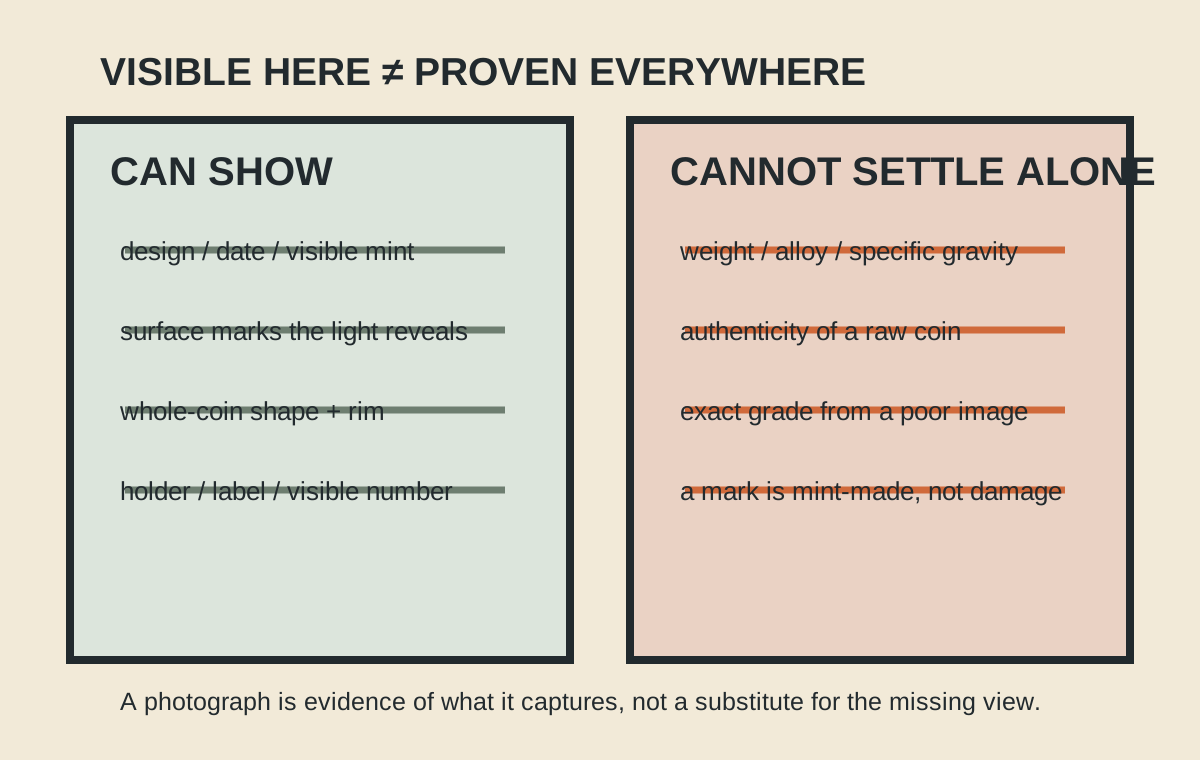
A COINHUNTER PUBLICATION • FIRST EDITION • 10¢
Pocket Treasures First Edition: a boy and dog examine a coin album under a green desk lamp; The Reality Check and Home Coin Studio; Editorial Style Inspired as a Tribute to The Saturday Evening Post.
THE REALITY CHECKSeven stories for the curious collector
POCKET TREASURES | VOL. 1 • NO. 1
CoinHunter
A NOTICE FROM COINHUNTER

A Modern Tool
for a Timeless Hunt.

The pleasure of finding something remarkable in ordinary change never grows old. When a second look becomes a question, CoinHunter belongs at the collector's side.

Keep the curiosity. Bring a sharper eye.

CONTENTS
Pocket Treasures First Edition contents page: The Reality Check, seven stories.

See the contents of this issue.

ADVERTISEMENT
CoinHunter house advertisement: A Modern Tool for a Timeless Hunt.

A message from CoinHunter.

FROM THE EDITOR

Welcome to Pocket Treasures

A coin may be ordinary in the morning and a question by afternoon. A scratch, a date, a mark or a story can make someone look again.

Our first issue is called The Reality Check because discovery is more interesting when it survives close inspection. Here are the actual seven stories selected for the inaugural edition, including our home coin photography studio.

“The trained eye sees what others spend.”

The Editorial Desk

Editor's Letter • POCKET TREASURES
01

Welcome to the Part Where We Actually Look

There is a moment in collecting when a coin stops being a small metal object and becomes a question.

What is it? Is the mark damage or a variety? Is the color natural or an accident of storage? Is the number in the listing a price, a wish, or a dare? Could it be rare? Could it be worth something? Could the person who posted it online simply be very committed to the number 4,999?

Pocket Treasures begins in that moment.

We are here for the pleasure of looking closely. We are also here for the less glamorous pleasure of finding out what the close look can support. Those are not opposite impulses. The second one protects the first.

A collection gets more interesting when you can say what you know, what you suspect, and what you still need to check. A good photograph can preserve an observation. A reference can narrow an identification. A completed sale can tell you more about a market than a dramatic asking price. None of these things removes the mystery. They give the mystery somewhere solid to stand.

This first issue is called The Reality Check because collecting is crowded with confident answers. An app can return a label before you have finished centering the coin. A listing can present an ordinary piece beside a spectacular number. A rare discovery can become a story about everybody's pocket change. A piece of gear can promise professional results while solving the much smaller problem of a shaky phone.

Our job is not to sneer at tools, sellers, beginners, or the occasional wonderful surprise. Our job is to separate jobs that are often bundled together. Identification is not grading. Grading is not authentication. An asking price is not a realized price. A possibility is not a probability. And an attractive photograph is not automatically a truthful one.

That last distinction is why our anchor starts at a kitchen table. Before the software, the marketplace, the loupe, or the slab, there is the object and the quality of the observation. We will show you how to make a stable, square, repeatable coin photograph with household materials, then explain what inexpensive equipment can improve. The finish line is not glamour. It is a picture another person can inspect without guessing what the photographer hid.

The same standard follows us to the Evidence Desk, where we take apart the many numbers that gather around a coin. We visit the places collectible material actually turns up, without pretending a bank roll is a treasure map. We pare the collector's toolkit down to supplies that earn their drawer space. We finish by drawing a boundary around photography: what a picture can show, and which questions still require weight, edge views, comparison, a holder record, or an expert.

There will be wonder here. There will also be a few sentences that end with “we do not know yet.” That is not a failure of enthusiasm. It is what keeps enthusiasm from turning into a bill.

Pocket Treasures is editorially independent from CoinHunter's product surfaces. We use no customer material in this issue, carry no sponsor, and include no affiliate links. Our contributors are desk identities, not pretend humans: the byline tells you what editorial role shaped the piece, and the source packet tells you why we believe the factual parts.

So put a coin on the table. Turn off the room light. Move the phone until it is square. Read the number as a clue, not a verdict. Then look again.

That is the whole magazine, more or less: preserve the pleasure, improve the question, and do not let a shiny answer do the looking for you.

— The Managing Editor

Bench Notes / Anchor • POCKET TREASURES
02

Build a Coin Photo Studio on a Kitchen Table

The most useful coin photograph is not the one that makes a worn coin look heroic. It is the one that lets another person see the same thing you saw.

That sounds modest. It is also harder than pointing a phone downward and tapping the screen.

A dependable setup needs three jobs covered: the phone must be stable, the light must describe the surface, and the coin must sit square enough that shape and lettering are not distorted. NGC's photography guidance puts the same three needs in plainer equipment language: lighting, camera support, and camera/lens. It also makes a useful admission—most phones can make a recognizable coin image, while macro equipment becomes valuable when you need more detail.

Start with what is already in the house.

The free setup

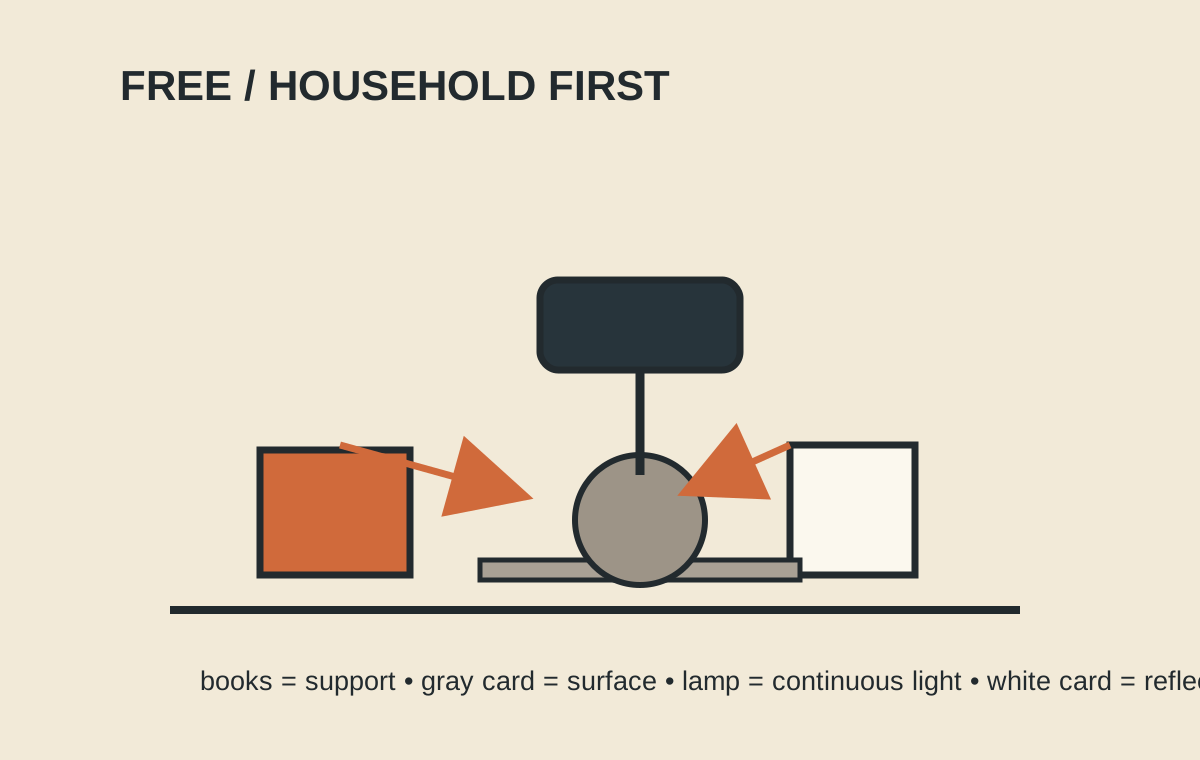
You need a clean table, a sheet of matte gray paper or card, a mug or two to act as weights, a stack of books, a piece of white paper or thin card, and a phone. A folded towel can keep the table from transmitting small bumps. A ruler or a square edge helps you judge alignment. None of this is elegant. It is stable, and stability is the luxury item.

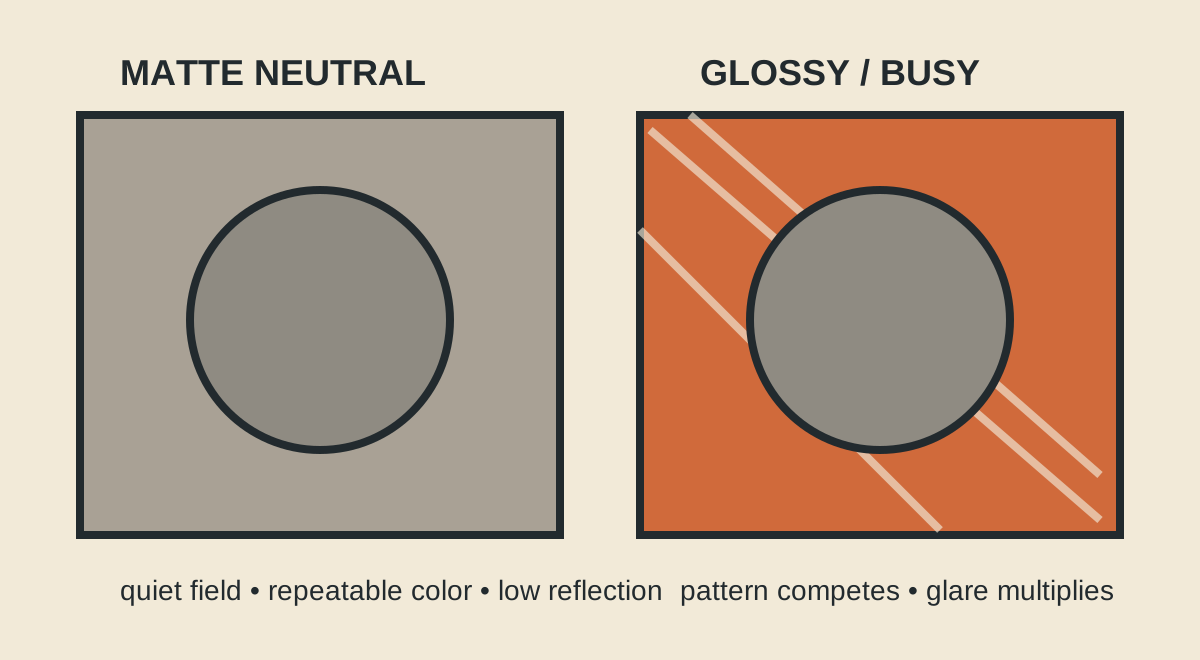
Use the gray card as the working surface. A neutral matte gray is a strong default because it is quiet, non-reflective, and less likely than a bright white surface to push the phone's exposure toward the wrong compromise. It also makes a useful visual reference when you compare one session with another. The surface does not need to be an expensive “coin photography” product. It needs to be clean, flat, and free of a distracting pattern.

Make a small phone bridge from books: two stacks at the same height with a gap between them, or a firm box with a hole cut into its top. The camera lens looks through the opening. Check that the phone cannot slide. If the phone is above the coin but tilted, you have built a tiny funhouse mirror.

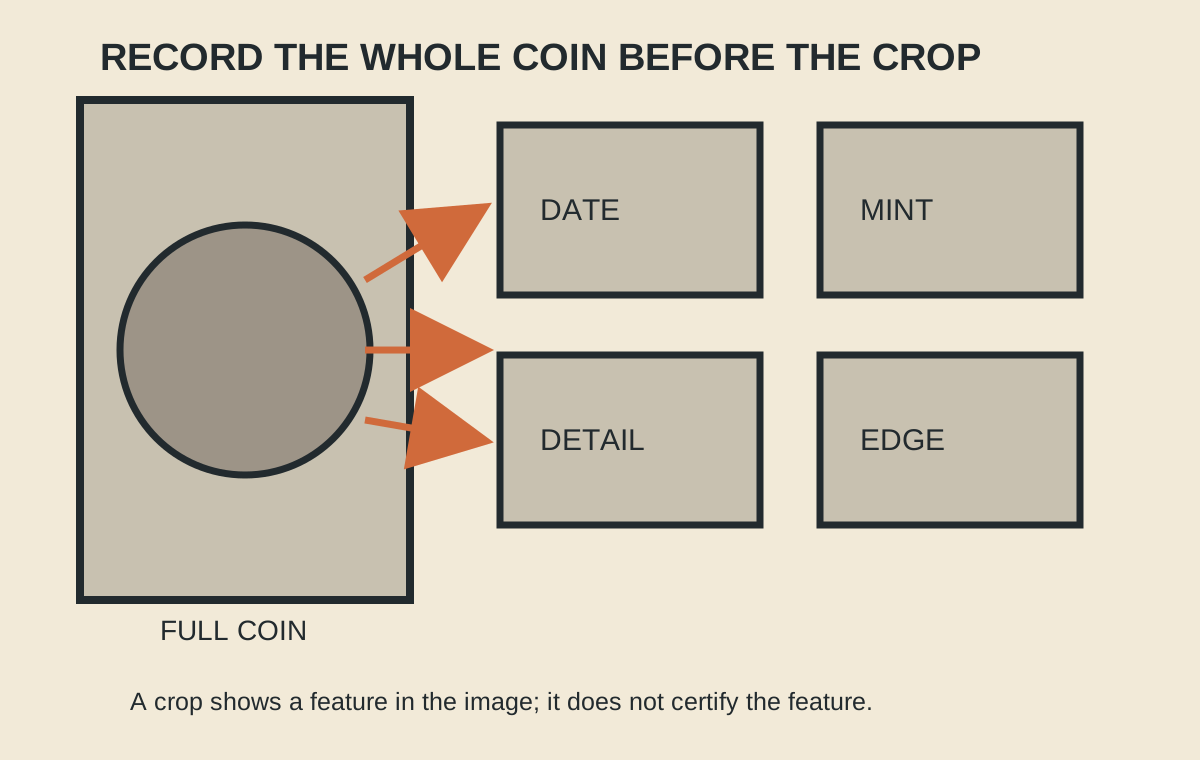
Place the coin in the center of the gray card. For a raw coin, handle it by the edge. For a slab, wipe the outside of the holder with a clean, soft cloth if needed; do not “improve” the coin inside it. Rotate the coin until the date and lettering sit in a natural reading position, then leave a little margin around the rim. The first photograph should include the whole coin. Detail crops come later.

Tap the coin on the phone screen to focus. If the phone offers exposure and focus lock, use them. Keep the exposure consistent across obverse and reverse, but do not force identical brightness if the surfaces genuinely reflect light differently. Turn off the ceiling lights and nearby lamps when they introduce mixed color or bright reflections. A phone is very good at accepting the most convenient light and calling it truth.

Use the timer. A two- or three-second delay is enough to let your hand leave the setup. If the phone supports a remote shutter or browser-based remote capture, that can be convenient, but a timer is the reliable substitute. Remote control reduces shake; it does not correct a crooked phone or a bad reflection.

Square first, close second

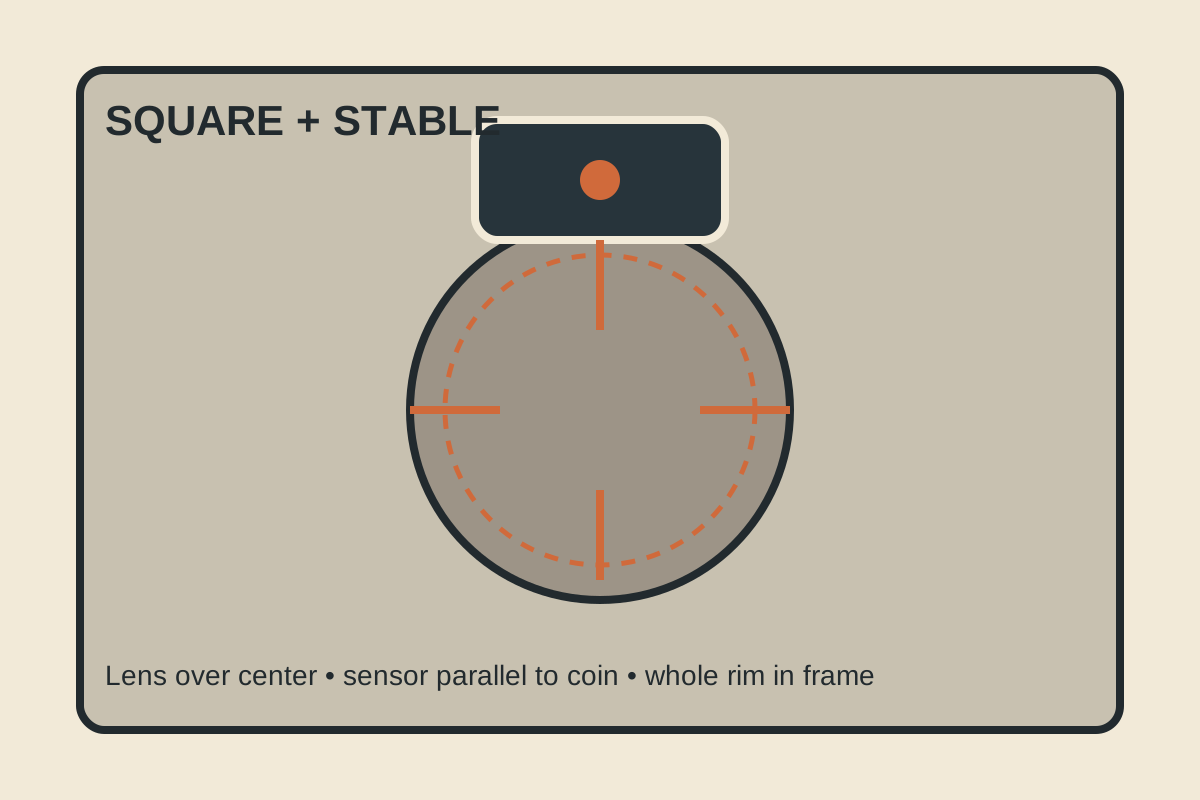
The phone's sensor should be parallel to the coin. In a top-down view, the lens should sit over the center of the coin, not somewhere above its shoulder. The coin should look circular, not egg-shaped. If the rim is wider on one side, stop and fix the geometry before buying a lens.

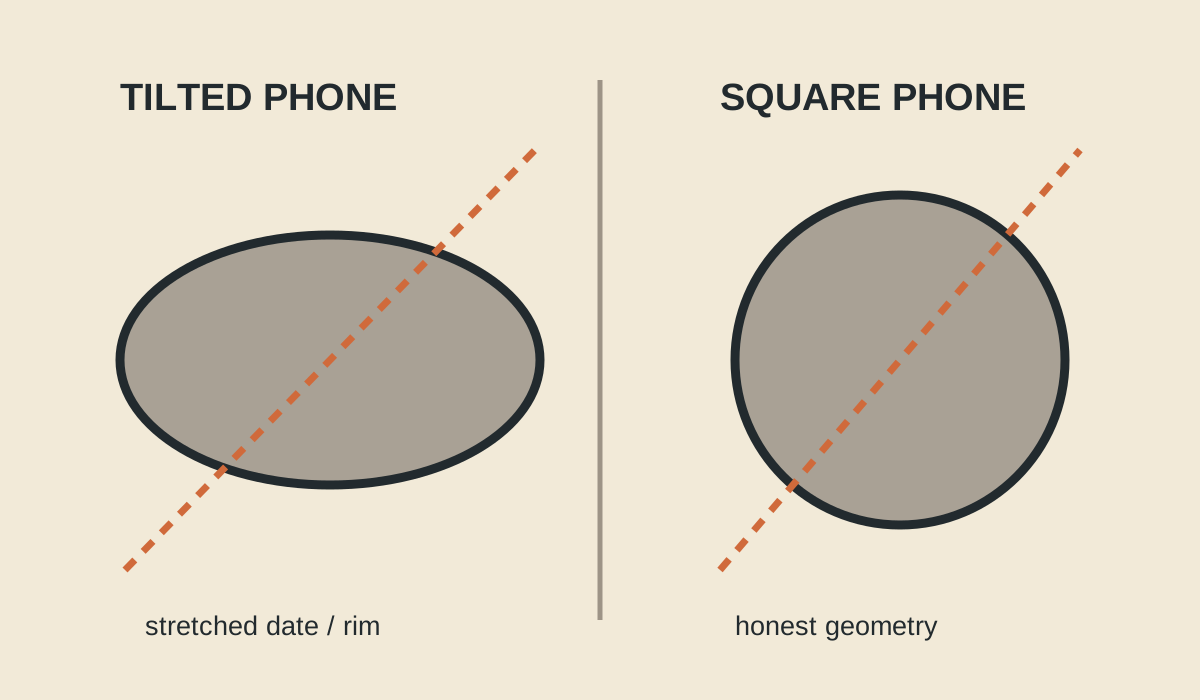
Perspective error makes a coin look more diagnostic than it is. A tilted phone can stretch a date, hide part of a rim, and change the apparent shape of a mark. The distortion may look dramatic because the coin is round and familiar; the cure is boringly physical. Raise one side of the support, move the phone, or use a small bubble level. Do not “correct” the shape in an editor and then forget that you corrected it.

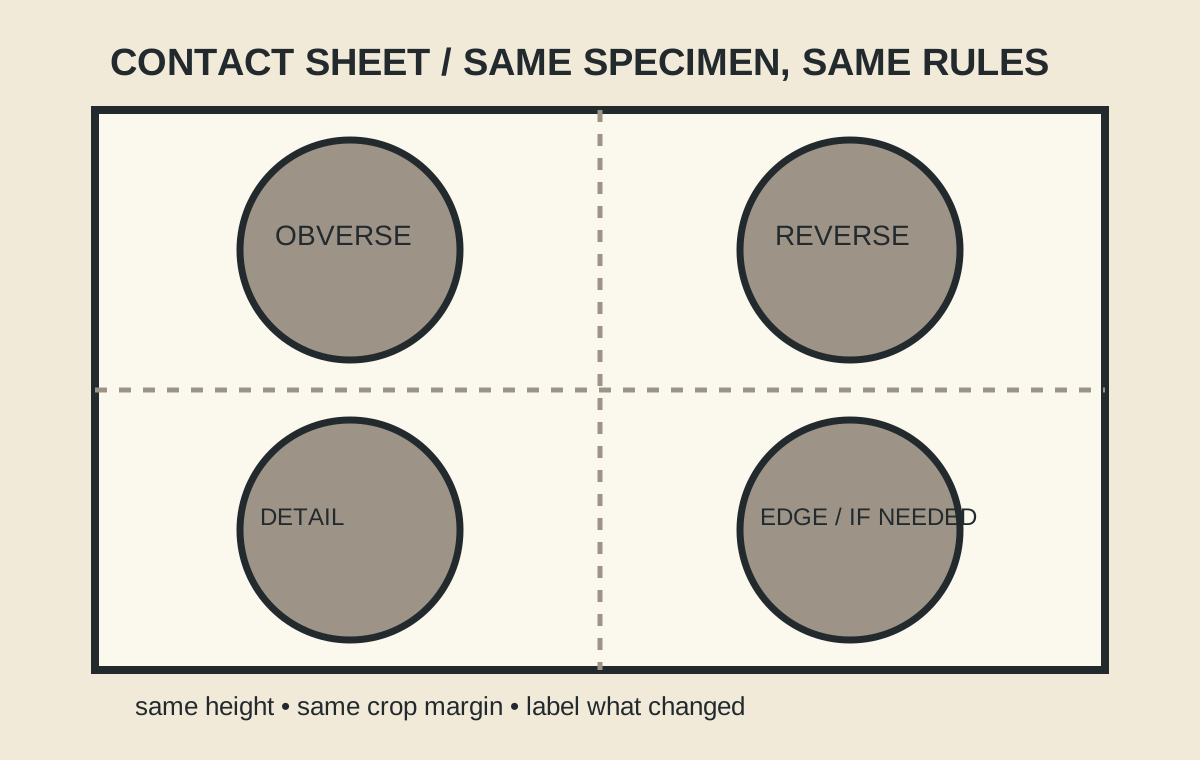
Make one repeatable obverse/reverse pair. Keep the camera height, surface, framing, and light positions the same. Mark the corners of the setup with removable tape if you expect to photograph a group. A matching pair makes it easier to compare surfaces and easier for someone else to know that the two images belong to the same specimen.

Light is a description, not decoration

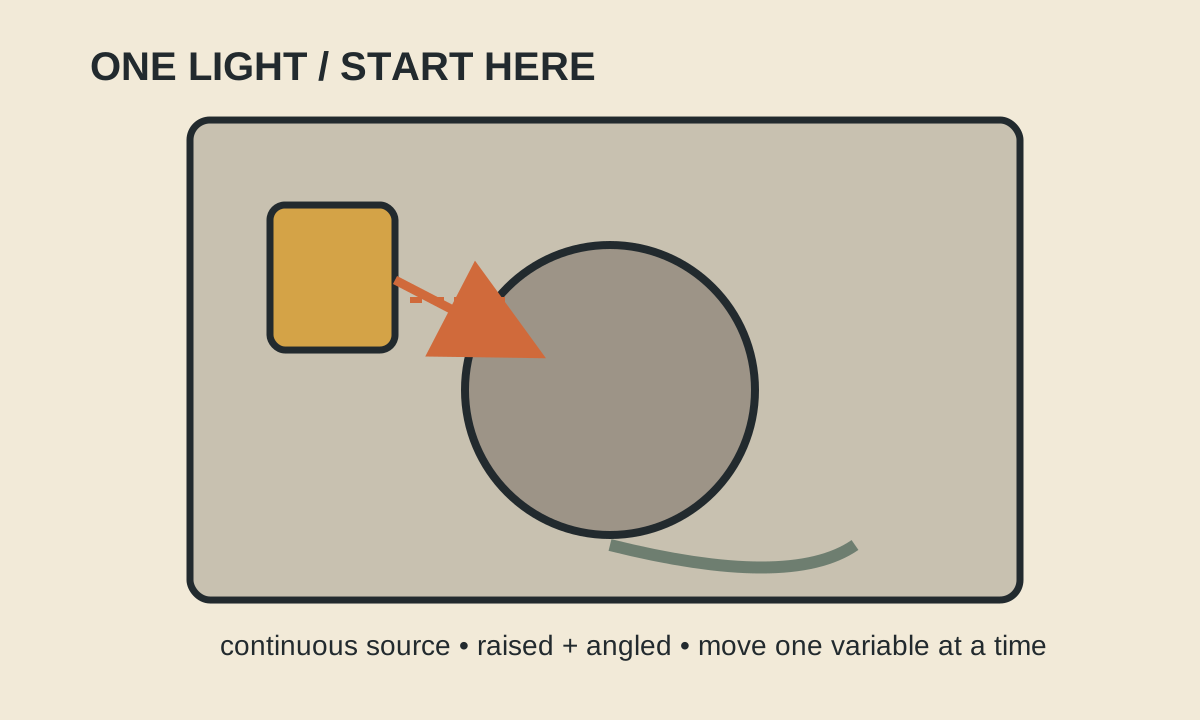
Continuous light is friendly to beginners because you can see the reflection before you take the picture. Start with one lamp or LED panel to the left or right, raised a little above the coin and aimed across its surface rather than straight down. Move the light farther away to make its angle less aggressive; move it closer or lower to bring out texture. Every coin will negotiate differently.

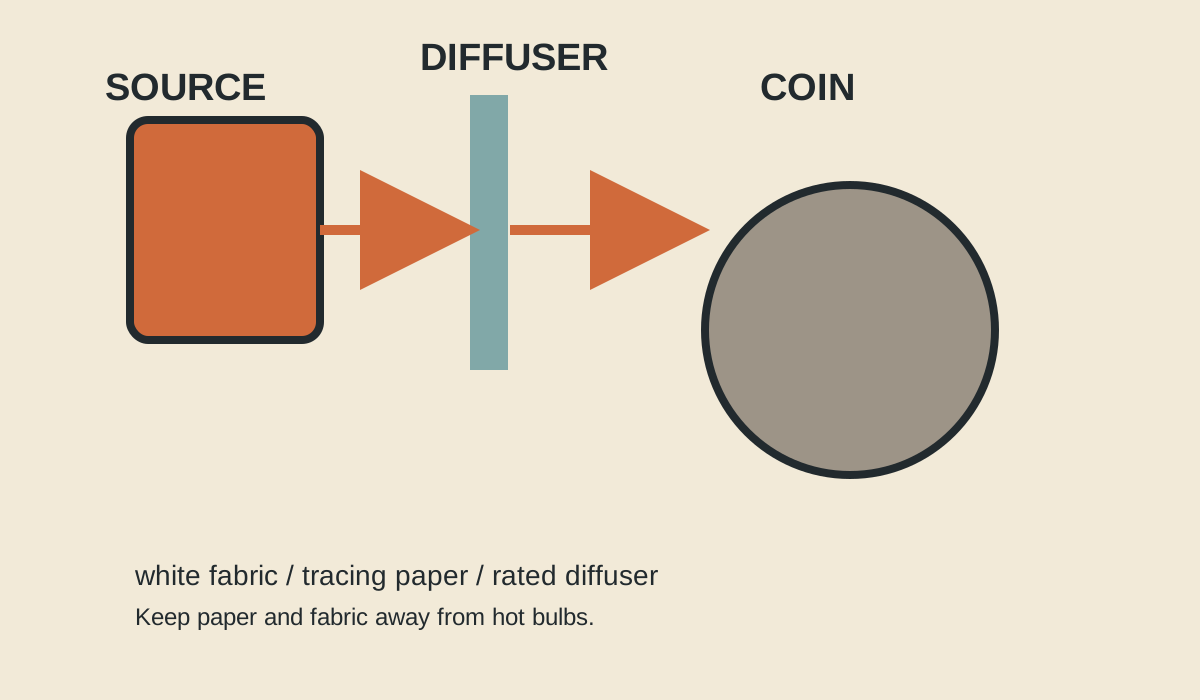
Diffusion is a thin, safe-to-handle layer between the source and the coin: white fabric, tracing paper, a translucent diffuser, or a small softbox rated for the light you are using. Keep paper and fabric away from hot bulbs. Diffusion enlarges and softens the source, which often makes glare less abrupt. It also costs some light, so lengthen the exposure or raise the phone slightly rather than turning on every lamp in the room.

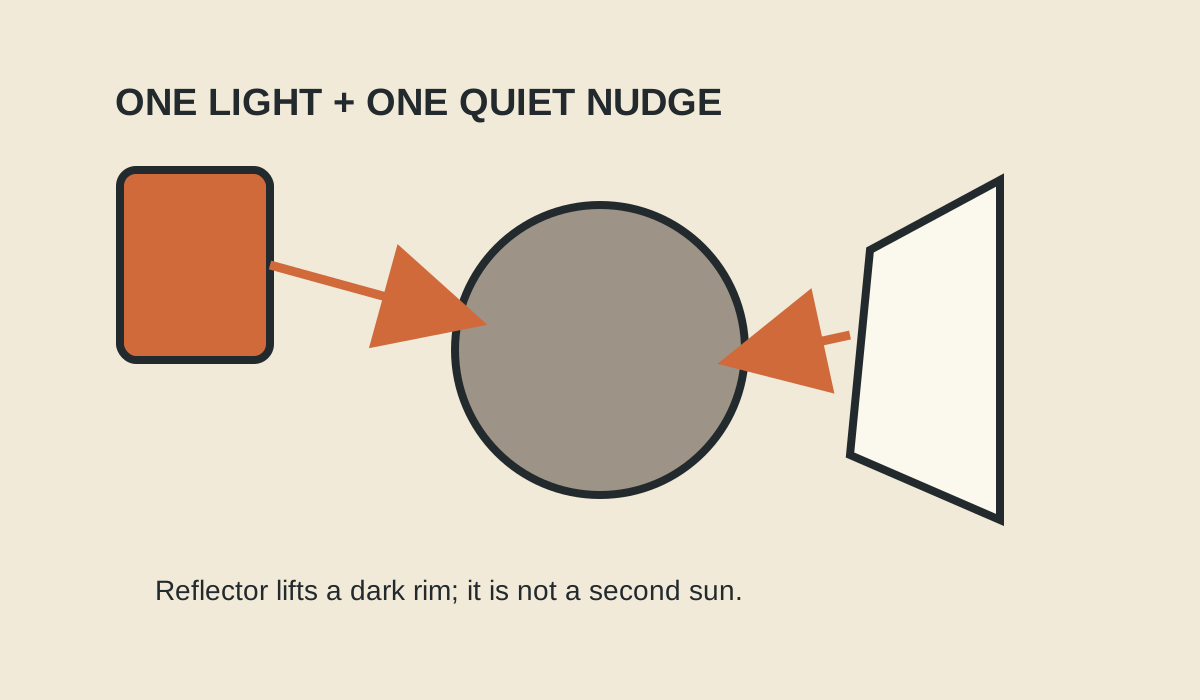
The white card is a reflector. Place it opposite the light to lift a dark rim or shadow. A reflector is not a second sun; it is a quiet nudge. PCGS's proof-coin examples show why this matters: a small reflector can define shape, while larger or poorly placed reflective surfaces can introduce color changes and unwanted objects into the image.

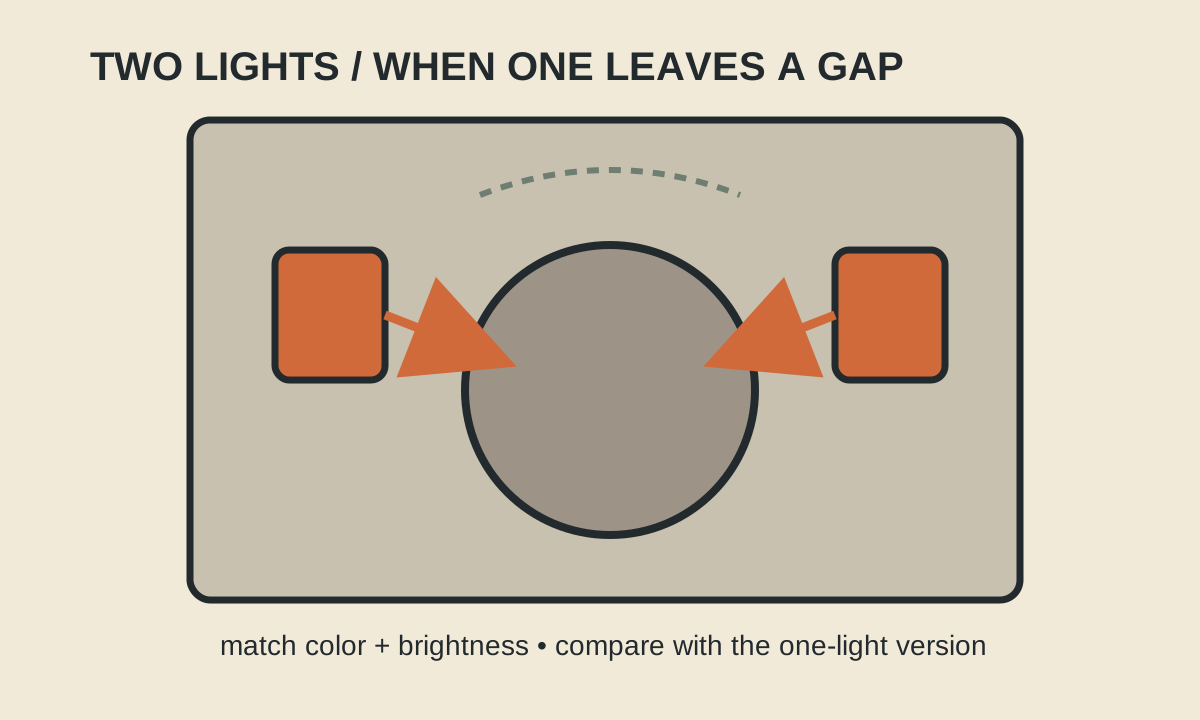
One light is often the best starting point. It gives you one variable to move and one reflection pattern to understand. Add a second light when the first setup leaves one side of the coin too dark or when you need a controlled, symmetrical record of a slab. Keep the two sources similar in color and brightness, place them as mirror images at roughly equal angles, and compare the result with the one-light version. More light is not automatically more information.

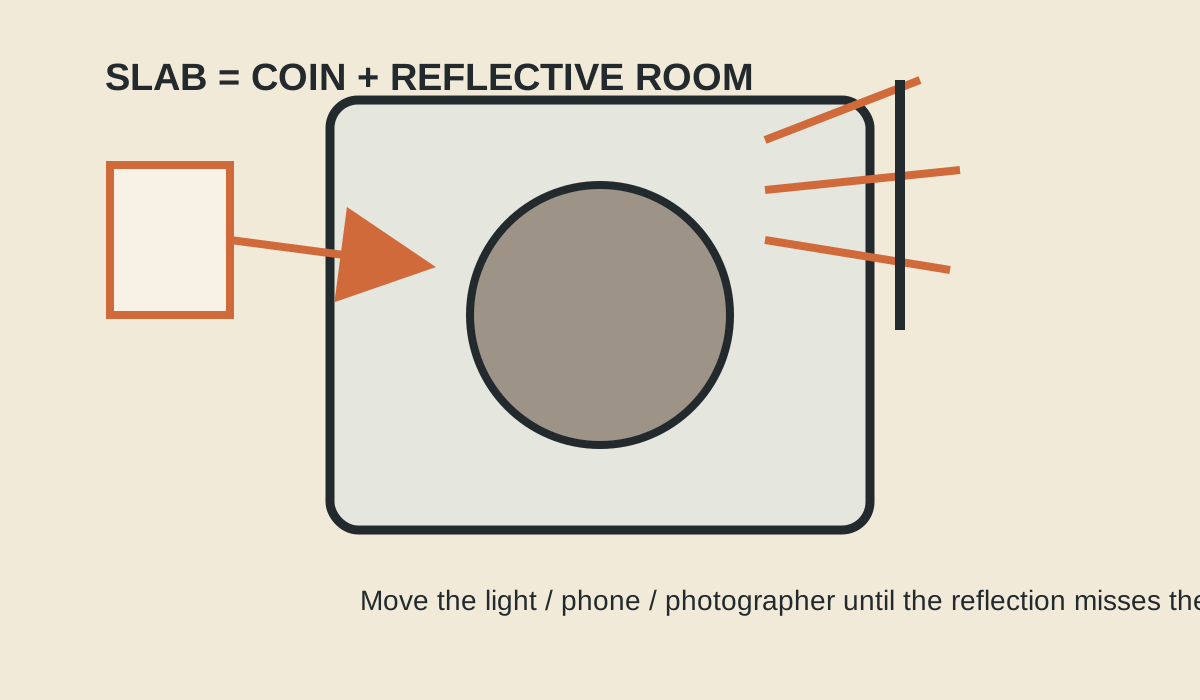
For slabs and proof surfaces, assume the room is part of the photograph. A slab is a clear reflective object around a coin. A proof coin has mirror-like fields and frosted design elements, so it is designed to show the light—and whatever else the light sees. Move yourself, the phone, and the light until the reflection falls outside the important area. A black shirt can become a dark stripe. A window can become a white rectangle. The coin has not changed; the room has entered the picture.

Toned coins can be especially sensitive to color. Avoid a mixed-light setup with a warm household lamp on one side and a cool window or LED on the other. Set the phone's white balance if the camera allows it, or use the same single light for the whole session. Do not increase saturation to rescue a dull screen. Record the color you saw, not the color that earns more clicks.

When the phone needs help

First test the phone's native camera. If it can focus on the full coin and preserve the date, mint mark, rim, and surface detail you need, stop there. Digital enlargement is not the same as new information, but a clean, well-lit full-coin image is often more useful than a soft macro image with a dramatic background.

Macro accessories become reasonable when the phone cannot focus close enough or when the subject detail is too small in the full frame. A clip-on macro lens may help, but it changes the working distance: the phone must sit closer to the coin, leaving less room for light and making the lens easier to bump. Some inexpensive lenses also introduce edge softness, flare, or alignment problems. Test the accessory on an ordinary coin before using it for a claim.

If a crop is meant to show a date or mint mark, capture the full coin first, then make the detail image with the same orientation and a note that it is a detail view. A detail crop is evidence of a detail in the photograph. It is not proof that the detail is genuine, correctly attributed, or valuable.

Three setups you can actually finish

Free / household

Matte gray card, phone on a book bridge, one shaded desk lamp or bright window used from one direction, white card reflector, timer, and a note with date, coin identity as known, and side photographed. Turn off competing lights. This setup costs nothing and teaches the geometry.

Low-cost improved

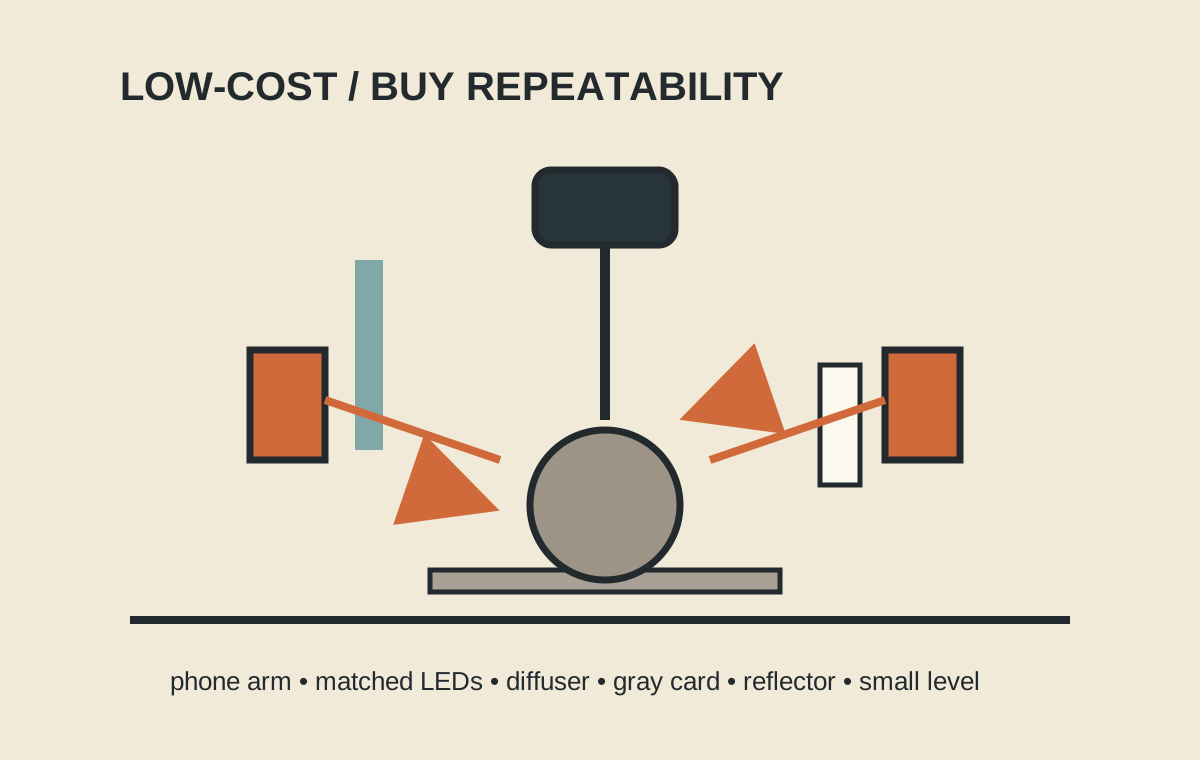
Small phone tripod or overhead arm, two identical dimmable continuous LEDs, diffusion, gray card, white reflector card, and a small level. Use one light first, then add the second only when it solves a visible problem. Put tape marks on the table for the phone and stands. This setup buys repeatability more than prestige.

Compact enthusiast

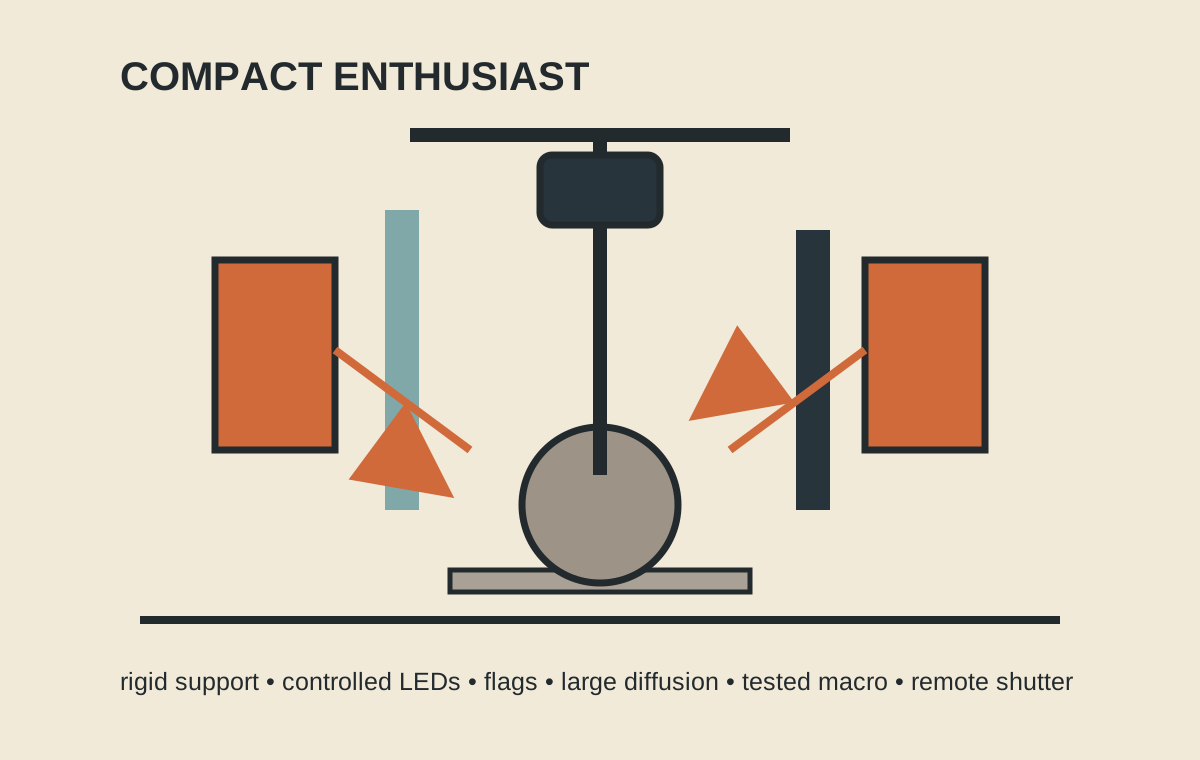
Rigid copy-stand-style support or overhead arm, controlled LED panels with matching color, larger diffusion, black flags for reflection control, a neutral gray surface, a remote shutter, and a macro solution tested for the phone. Add a scale or reference card only when it belongs to the record you are making. Keep an unedited original and a clearly labeled presentation crop.

The purchase order is simple: support first, light second, diffusion and a neutral surface third, macro last. If the image is crooked, a sharper lens only produces a sharper crooked image.

A repeatable session, start to finish

Put the coin, phone support, and light in place before you open the camera app. Take one test frame with the whole coin visible. Look at the rim, the date, and the darkest and brightest areas. If the rim is stretched, fix the phone. If the date is lost in glare, move the light. If the surface color is drifting, remove the competing light. These decisions are faster before you photograph a dozen coins the wrong way.

Once the geometry works, make a reference frame. It can be a plain full-coin image with a small handwritten card outside the crop showing the specimen number and side. The card is for organization, not for scale claims. Photograph the obverse, turn the coin without changing the phone or light, and photograph the reverse. If you cannot keep the coin centered after turning it, mark a soft outer guide on the gray card or use a low, non-marring positioning aid outside the important surface.

Then make detail views only where a reader has a reason to look: date, mint mark, a possible die feature, an unusual rim, or the edge. Keep the full image next to each crop. Do not let a dramatic detail replace the boring establishing shot. The establishing shot is how a second person knows the crop belongs to this coin.

At the end of the session, save the untouched originals before making presentation crops. If you adjust exposure or white balance for a web page, keep that version separate and label the adjustment. A presentation crop can be cleaner than the original while remaining honest; it becomes misleading when the clean version is the only version left.

Seven ways to ruin a coin photo without touching the coin

  • Tilt the phone and call perspective a diagnostic.
  • Let a ceiling light, window, and desk lamp fight over the color.
  • Photograph through a slab with a bright rectangle reflected across the coin.
  • Push saturation until toning becomes a sales pitch.
  • Use a patterned or glossy background that competes with the rim.
  • Crop away the rim, date, or mint mark before anyone else can inspect it.
  • Retouch marks, glare, spots, or luster without labeling the change.

The minimum record

For every specimen, save the original file and a simple note. Photograph:

Obverse / Reverse / Date / Mint / Detail / Edge when relevant

Add the capture date, device, lighting setup, and any reason the second image differs from the first. If the coin is slabbed, record the service and visible certification number separately from your own observations. If it is raw, do not give it a grade just because the phone found a pleasing angle.

The goal is not a glamorous coin. The goal is a photograph another person can trust.

Source note: The technique in this piece is an editorial synthesis of NGC and PCGS photography guidance, with proof-finish terminology checked against the U.S. Mint. The diagrams are original illustrations, not documentary photographs or product endorsements.

Top-down phone centered and parallel above a coin with square alignment guides.
PLATE 1 — Top-down phone centered and parallel above a coin with square alignment guides.
Stretched oval coin result labeled tilted phone beside a round result labeled square phone.
PLATE 2 — Stretched oval coin result labeled tilted phone beside a round result labeled square phone.
One continuous lamp is raised and angled across a coin on a tabletop.
PLATE 3 — One continuous lamp is raised and angled across a coin on a tabletop.
Two matching continuous lights flank a coin at equal angles.
PLATE 4 — Two matching continuous lights flank a coin at equal angles.
A translucent diffuser sits between a lamp and a coin to soften the source.
PLATE 5 — A translucent diffuser sits between a lamp and a coin to soften the source.
A white card opposite a lamp bounces a small amount of light onto a coin.
PLATE 6 — A white card opposite a lamp bounces a small amount of light onto a coin.
A slabbed coin is shown with a flagged bright window reflection outside the coin.
PLATE 7 — A slabbed coin is shown with a flagged bright window reflection outside the coin.
A coin on a quiet matte gray field is compared with one on a glossy patterned field.
PLATE 8 — A coin on a quiet matte gray field is compared with one on a glossy patterned field.
Four labeled contact-sheet cells show obverse, reverse, detail, and edge views on a common grid.
PLATE 9 — Four labeled contact-sheet cells show obverse, reverse, detail, and edge views on a common grid.
A full coin image points to separate date, mint, detail, and edge crops.
PLATE 10 — A full coin image points to separate date, mint, detail, and edge crops.
Books support a phone over a coin while a lamp, gray card, and white reflector complete the setup.
PLATE 11 — Books support a phone over a coin while a lamp, gray card, and white reflector complete the setup.
A phone arm, matched LED panels, diffuser, gray surface, reflector, and level form a tabletop setup.
PLATE 12 — A phone arm, matched LED panels, diffuser, gray surface, reflector, and level form a tabletop setup.
A rigid copy stand, controlled LEDs, flags, diffusion, and a phone macro setup frame a coin.
PLATE 13 — A rigid copy stand, controlled LEDs, flags, diffusion, and a phone macro setup frame a coin.
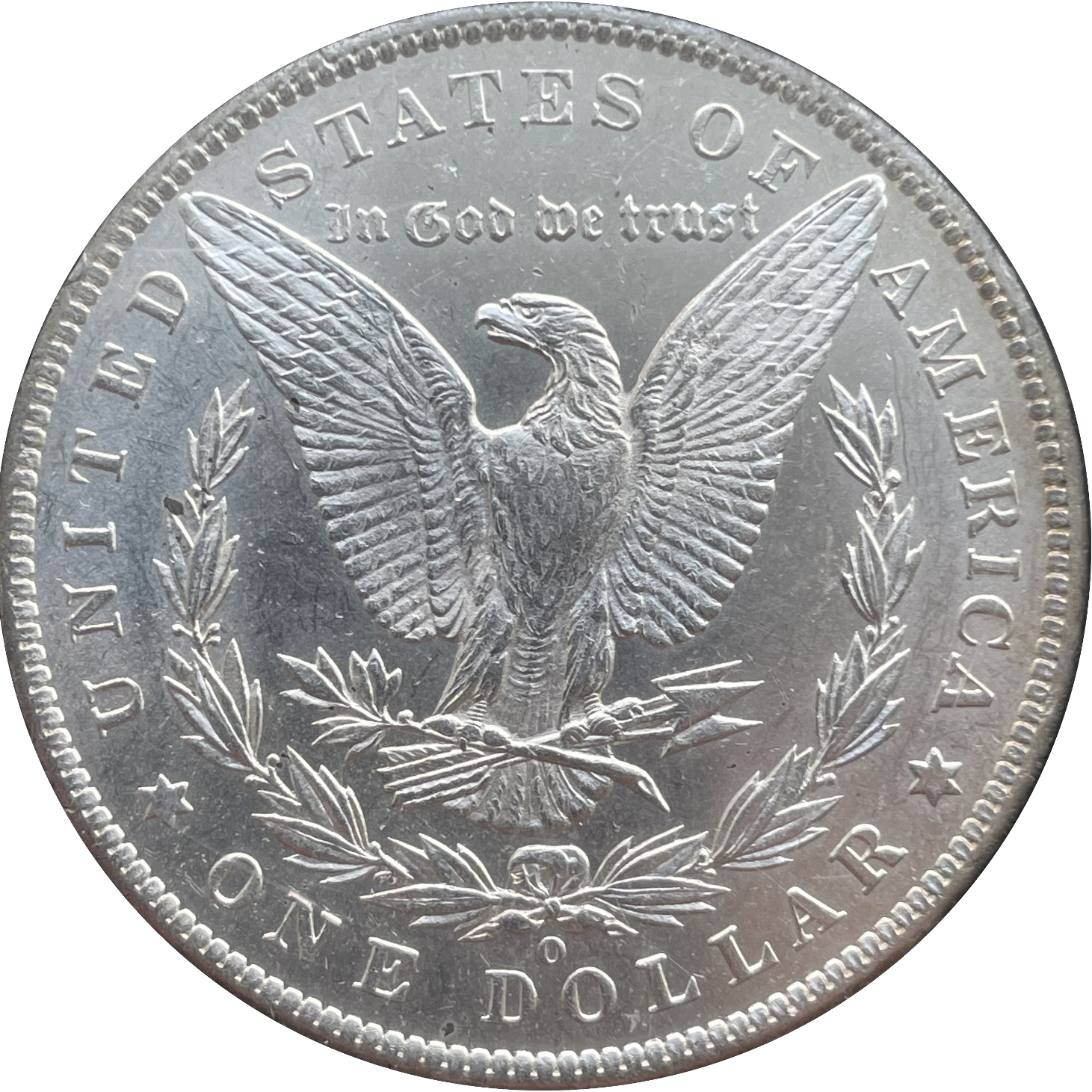
Close view of the reverse of an 1885-O Morgan dollar, showing the eagle and inscriptions.
PLATE 14 — Close view of the reverse of an 1885-O Morgan dollar, showing the eagle and inscriptions.
CoinHunter
A COINHUNTER HOUSE NOTICE

Every Coin
Has a Story.

Some stories need a little help being seen. Study the details, compare what you find, and carry the hunt beyond the kitchen table.

A modern companion to a timeless pastime.

Evidence Desk • POCKET TREASURES
03

The Number in the Listing Is Not the Market

The fastest way to make a coin expensive is to place it in a listing and type an expensive number beside it.

The second-fastest is to find one spectacular sale and treat it as a promise.

Collectors deserve better numbers than that. The first step is to stop calling several different things “the price.”

A short dictionary for a noisy room

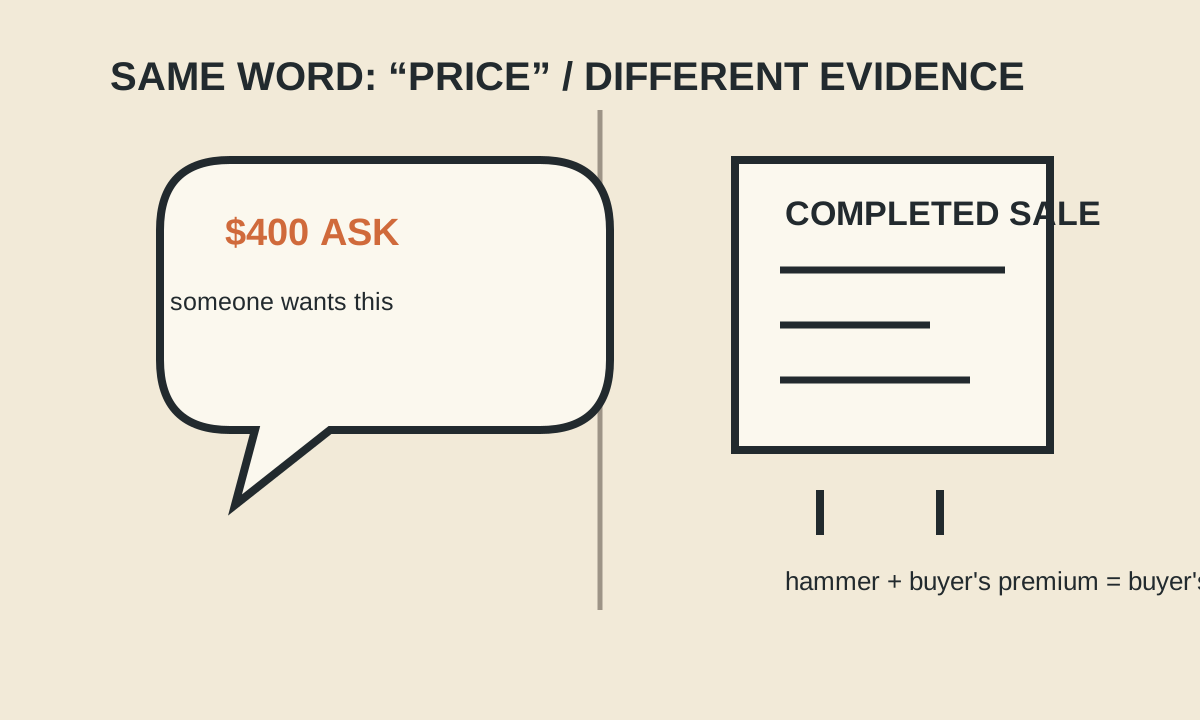
Asking price is what a seller wants. Heritage's coin glossary defines “ask” as the lowest current asking price offered for a particular issue and grade. It is a useful observation about an offer, not proof that anyone has accepted it.

Offer is a proposed purchase price. It may be accepted, refused, or negotiated. An offer that never becomes a transaction is evidence of interest, not evidence of market clearing.

Bid can mean the amount a buyer is willing to pay, or, in a dealer context, the level at which a dealer may buy. Read the venue's definition. A bid is not necessarily money in your hand.

Hammer price is the winning bid called by the auctioneer. Buyer's premium is the additional fee charged to the winning bidder. The buyer's invoice can therefore be higher than the hammer. A sale record may report the hammer, the total including premium, or both. Write down which one you are looking at.

Realized price is the reported outcome of a completed transaction. In an auction context, confirm whether the published result includes the buyer's premium. Two auction houses can use the same word while presenting the total differently.

Guide price is an estimate or reference value produced by a price guide. A guide can be extremely useful without being an offer to buy. Heritage's own glossary warns that its value ranges are indications, not offers, and that eye appeal, rarity, grade, and service can move an individual coin above or below the range.

Dealer retail is a seller's price. Dealer buy is the level a dealer may offer to acquire material, subject to inspection and the dealer's needs. The spread is not a moral failure; it is part of how inventory, expertise, overhead, and risk are paid for. It is also why a retail listing does not tell you what you can expect to receive tomorrow.

Bullion or face floor is a context, not a guarantee. A coin may have a legal denomination or a metal value while still having a different numismatic market. Condition, authenticity, weight, fineness, demand, and transaction costs still matter.

Read the comparable, not the fantasy

Suppose you find three online listings for the same date. One asks $18, one asks $40, and one asks $400 because the seller has been blessed by the algorithm. You have learned that three people typed three numbers. You have not learned the clearing price.

Now suppose you find three completed sales. That is better, but the work is not over. Are the coins the same date, mint, variety, and problem status? Are they similarly preserved? Are they raw or certified? If certified, are they in the same service and grade? Does the image show a cleaned or damaged piece? Was the total inclusive of the premium? Did one coin carry an unusual pedigree, color, or holder that a routine example will not share?

PCGS's Auction Prices Realized guidance makes the same caution in less domestic language: auctions are individual events. A determined pair of bidders can push one coin high; a thinly attended sale can produce a low result. Its price-guide team also says it considers factors such as eye appeal, toning, population, and how long a coin has been away from the market. That is not a formula for certainty. It is an argument against pretending a single result is one.

The useful unit is a comparable set with its differences written down.

A clean way to make a small evidence table

For each example, record:

  • date and mint, including the variety if relevant;
  • grade or a plain condition description;
  • raw, slabbed, or details designation;
  • transaction channel;
  • sale date;
  • hammer, premium, and realized total when available;
  • shipping, tax, or platform fees if they materially change the buyer's cost;
  • image and description quality;
  • unusual color, provenance, holder, or other attribute;
  • whether the result actually completed.

Five carefully described comparables beat twenty mystery screenshots. If only one close comparable exists, say so. Thin evidence is still evidence; it just does not deserve a thick conclusion.

Why outliers deserve a footnote, not a crown

An outlier may be telling you something real. Perhaps the coin has exceptional eye appeal, a top population position, a famous provenance, or two bidders who wanted it on the same afternoon. It may also be a mismatched grade, a problem coin, a data-entry error, or a result presented on a different price basis. The correct response is investigation, not deletion and not worship.

PCGS's own market discussion warns that unusual holders, toning, population context, and time away from the market can influence a result. The guide is not saying those variables are noise. It is saying they belong in the description. If you remove the context, you have not made the number cleaner; you have made it less true.

For a common coin, the most useful value statement may be a range with a date and channel attached. For a rare or thinly traded coin, the most honest statement may be “recent evidence is sparse.” A reader can act on both. A fake precise number only gives the reader something to repeat.

The five-question value sniff test

Before repeating a number, ask:

  • What exactly is being priced? Date, mint, denomination, variety, grade, problem status, and authenticity all matter.
  • Was it sold or merely offered? If sold, what did the record include: hammer, premium, or total?
  • How close is the comparison? A different grade, holder, eye appeal, or variety may be a different market.
  • How many recent examples do we have? One result can be an outlier; ten weakly matched results can be noise with better posture.
  • What would change the answer? A better attribution, an altered surface, a certification check, a new sale, or simply a buyer who wants this coin very badly?

The last question is the grown-up one. Value is not a permanent property stamped into the metal. It is a market judgment about a particular object in a particular condition, through a particular channel, at a particular time.

That is why a price guide, an auction archive, a dealer conversation, and an online listing can all be useful while disagreeing. They are answering different questions. Your job is to keep the questions attached to the numbers.

Source note: Definitions and market cautions were checked against Heritage's numismatic glossary and auction guidance plus PCGS Auction Prices Realized and price-guide methodology. This issue includes no current price claim, no copied marketplace screenshot, and no universal valuation of a specimen.

An open asking-price bubble is compared with a completed-sale receipt separating hammer and buyer's premium.
PLATE 1 — An open asking-price bubble is compared with a completed-sale receipt separating hammer and buyer's premium.
The Scout • POCKET TREASURES
04

Five Places Worth Looking Without Pretending There Is a Treasure Map

Collectible coins do not require a cinematic entrance. They turn up in ordinary channels because ordinary people move, save, forget, inherit, sort, spend, and occasionally decide that the jar on the shelf has become somebody else's problem.

The useful question is not “Where is the secret spot?” It is “Which places can I search respectfully, what kind of material might be there, and what will I do when the answer is mostly ordinary?”

Here are five places worth learning.

1. Change and family accumulations

Start with the places already connected to your life: desk drawers, old purses, travel bowls, coat pockets, inherited jars, and the small containers that appear near a washing machine as if coins reproduce in the dark.

The advantage is context. You may know how long the material has been sitting, who handled it, and whether an older relative kept foreign change or commemoratives. The disadvantage is selection bias: the interesting piece may already have been removed, or the whole group may be modern face-value coinage. That is not a bad result. It is a clean baseline.

Sort by denomination and country, keep the pieces together until you understand the group, and photograph anything you set aside. If an accumulation is inherited, ask before separating sentimental or family-associated material. A coin can be historically ordinary and personally irreplaceable.

2. Rolls and teller finds

Roll hunting can be a pleasant way to inspect a lot of circulating material, but a bank is not a vending machine for rarities. Ask what the branch is comfortable providing, follow its limits, and return unwanted coins in a way that does not create extra work for a teller who did not volunteer to become your co-author.

The opportunity is volume and repetition. You learn what wear, discoloration, date ranges, and ordinary damage look like. You may encounter a coin that deserves a second look. You may also spend an evening discovering that most cents are, in fact, cents. Both outcomes are educational.

Do not describe a favorite branch, a good week, or a friend's lucky box as a hit rate. Anecdote tells you what happened once. Probability needs a defined sample over time, and most casual roll searches do not have one.

3. Coin shops, shows, and the low-cost tray

Coin shops and shows are useful because they put material, reference knowledge, and comparison in the same room. A junk box or low-cost tray can be especially good for learning: common dates, circulated surfaces, world coins, tokens, and the sort of piece that teaches you why attribution takes patience.

Look before you buy. Ask whether a coin is priced individually, sold by the group, or marked as a problem piece. If you are new, say so. A good dealer can explain what you are seeing; you are still responsible for listening, asking about returns, and paying a price you understand.

At a show, let people inspect material without hovering over their shoulders. Keep food and open drinks away from coins. The bourse is a work environment that happens to contain a lot of small history.

4. Estate sales, garage sales, flea markets, and antique environments

These places offer mixed context rather than reliable yield. You might find a family accumulation, a box of world coins, a dealer's leftovers, a souvenir token, or a container whose label is more optimistic than its contents.

The work is triage. Look for intact groups, readable labels, and signs that the material has been stored safely. Handle raw coins by the edge. Ask permission before opening a box or moving a display. If the seller says the group belonged to a family member, treat the information as provenance to record, not as proof of rarity.

Buy only what you can identify well enough to accept. “It might be something” is a fine reason to research a coin. It is not a fine reason to pay a price based on the most exciting possibility.

5. Inherited and forgotten household material

This is less a location than a responsibility. Attics, closets, safe-deposit boxes, and the backs of drawers can contain the best story in the issue—or a stack of old receipts and a 1976 souvenir set. Begin slowly.

Make a table of contents before making a valuation. Photograph groups in place, note labels and family names, and keep coins associated with their original envelopes until you understand what you have. Move material out of hot, damp, or unstable storage. If soft plastic is sticky, cloudy, or leaves residue, stop and ask a knowledgeable dealer or conservator before cleaning anything.

The first job is preservation, not monetization. A family collection deserves a record even when its financial value is modest.

A possible sixth place: the circulation oddity

Everyday change is worth examining because it is available, not because it is a secret pipeline. A bent coin, a damaged coin, and a genuine mint-made error can look exciting in the same two-inch photograph. Keep the categories separate. Photograph both sides and the edge when relevant, compare against a normal example, and use a recognized reference before using the word “error.”

The scout's real advantage is not access to a magical channel. It is a habit of noticing without inflating. Search where the material is, learn the local manners, keep a record, and let the ordinary pieces teach your eye. If a better coin appears, excellent. If not, you still leave with a better map of reality—and that map is reusable.

The etiquette that keeps the search possible

Ask before sorting. Return trays and rolls in the condition the owner expects. Do not photograph a dealer's inventory for resale or use another collector's find as your content without permission. If a seller has priced a coin incorrectly in your favor, decide what kind of collector you want to be before the moment arrives. Bargaining is part of some venues; ambush is not.

At banks and teller windows, remember that the staff's job is banking. A request made politely can be declined politely. At estate sales and family cleanouts, do not turn another person's uncertainty into a performance. If a group is beyond your knowledge, make an offer you can defend or leave it. Curiosity is not a license to create pressure.

Turn a search into a record

After a trip, write down the channel, the time spent, what you looked through, what you set aside, and what you learned. You do not need a spreadsheet worthy of a government census. A line such as “two hours, three trays, one useful comparison coin, no purchase” is enough to keep memory honest.

Over several visits, the record may reveal what that channel is actually good for. A shop may be excellent for world coins and poor for a particular U.S. series. An inherited jar may be rich in family history and empty of scarce dates. A show may teach you more in one afternoon than a month of scrolling. Let the outcome be specific. “Not a jackpot” is not the same as “not worthwhile.”

The treasure map, if one exists, is made from these small observations. It points toward better questions, not guaranteed finds.

Source note: Storage, handling, and beginner guidance were checked against ANA and PCGS educational material. The channel descriptions and expectations are editorial field advice; they are not claims of guaranteed yield.

The Curator • POCKET TREASURES
05

The Boring Tools That Keep Winning

The internet would like you to believe collecting begins when a package arrives.

It does not. Collecting begins when you can see, handle, record, and store what you have without making the object worse. The first tools are therefore not glamorous. They are the tools that remove preventable uncertainty.

1. Neutral light

Use a bright, stable light that lets you inspect surfaces without guessing. Daylight can work, but a window changes with weather and time. A single consistent lamp is often easier to repeat. For photography, continuous light gives you a chance to see glare before you press the shutter; diffusion can soften a harsh reflection.

Do not confuse brightness with quality. A bare bulb can be bright and unhelpful. Move the light, change the angle, and look for luster, hairlines, spots, and surface disturbance. A white card can lift a shadow. It does not need a marketing department.

2. Appropriate magnification

A 5× or 10× loupe is a useful starting point for dates, mint marks, lettering, and surface checks. A phone camera can provide a larger view for documentation. A microscope is useful when the question genuinely lives at that scale; it is also very good at turning every contact mark into a crisis.

Magnification does not create a diagnosis. It enlarges what is there, including dirt, scratches, and your own hope. Compare the suspect area with a normal example and a recognized reference before naming a variety or error.

3. A neutral working surface

Use a clean matte card, tray, or folded cloth in a quiet color. It keeps a coin from sliding and makes photographs easier to compare. Avoid loose grit, rough fabric, and glossy surfaces. A soft surface is helpful only if it is clean and does not shed fibers into the work.

For raw coins, keep the face off the table when possible and hold the piece by the edge. For a slab, keep the plastic from sliding into a bright reflection. Your work surface should support the coin, not become part of the story.

4. Safe handling and storage

The boring rule is the durable one: raw coins are held by their edges. Fingerprint residue can permanently change a surface, and the damage may not be visible immediately. Use clean, dry hands and work over a table rather than a hard floor.

For long-term storage, choose holders made from stable, inert materials. Avoid soft PVC flips. PCGS and NGC both document the risk of residues and surface damage from poor storage. Keep collections in a dry, reasonably stable environment away from direct sun and large swings in heat and humidity. If a holder is cloudy, sticky, or leaving film, ask for help before trying to polish the problem away.

5. A documentation habit

Use a notebook or a simple spreadsheet. Record the country, denomination, date, mint mark, source, purchase context, storage location, and what remains uncertain. Photograph both sides and the edge when it matters. Keep the original image, not only the crop that made the date look best.

This record pays off twice. It helps you find your own material, and it prevents a guess from hardening into a fact because you wrote it down six months ago. Add the date when you checked a reference or market result. Sources age; notes should admit that.

What can wait in the shopping cart

You probably do not need a motorized turntable, a cabinet of specialty tweezers, five grades of magnification, or a dozen lights before you can tell whether your phone is crooked. You do not need a proprietary background to replace a clean matte card. You do not need a device that promises a grade if you have not yet learned to compare wear, marks, luster, and problems under consistent light.

Buy the missing capability, not the most impressive object. If photographs shake, solve support. If surfaces disappear in a white flare, solve light and reflection. If notes vanish, solve documentation. If storage is unsafe, solve the holder. The order is pleasantly unglamorous, which is how you know it is probably useful.

There is also a tool that costs nothing: a stopping rule. Decide in advance how long you will inspect a jar, how much you will spend on an uncertain group, or how many references you will check before setting a coin aside for later. A stopping rule protects attention as effectively as a case protects a coin.

Before you buy another gadget

Ask what job it will perform. If the answer is “make me feel more professional,” put the money toward a better light, a stable phone support, a safer holder, or a reference you will actually open. The best tool in a collection is often the habit that makes the next observation comparable to the last one.

Source note: Handling and storage cautions were checked against ANA, PCGS, and NGC educational and conservation guidance. The priority order is editorial advice, not a product ranking.

Visual Service • POCKET TREASURES
06

What a Good Coin Photograph Can and Cannot Tell You

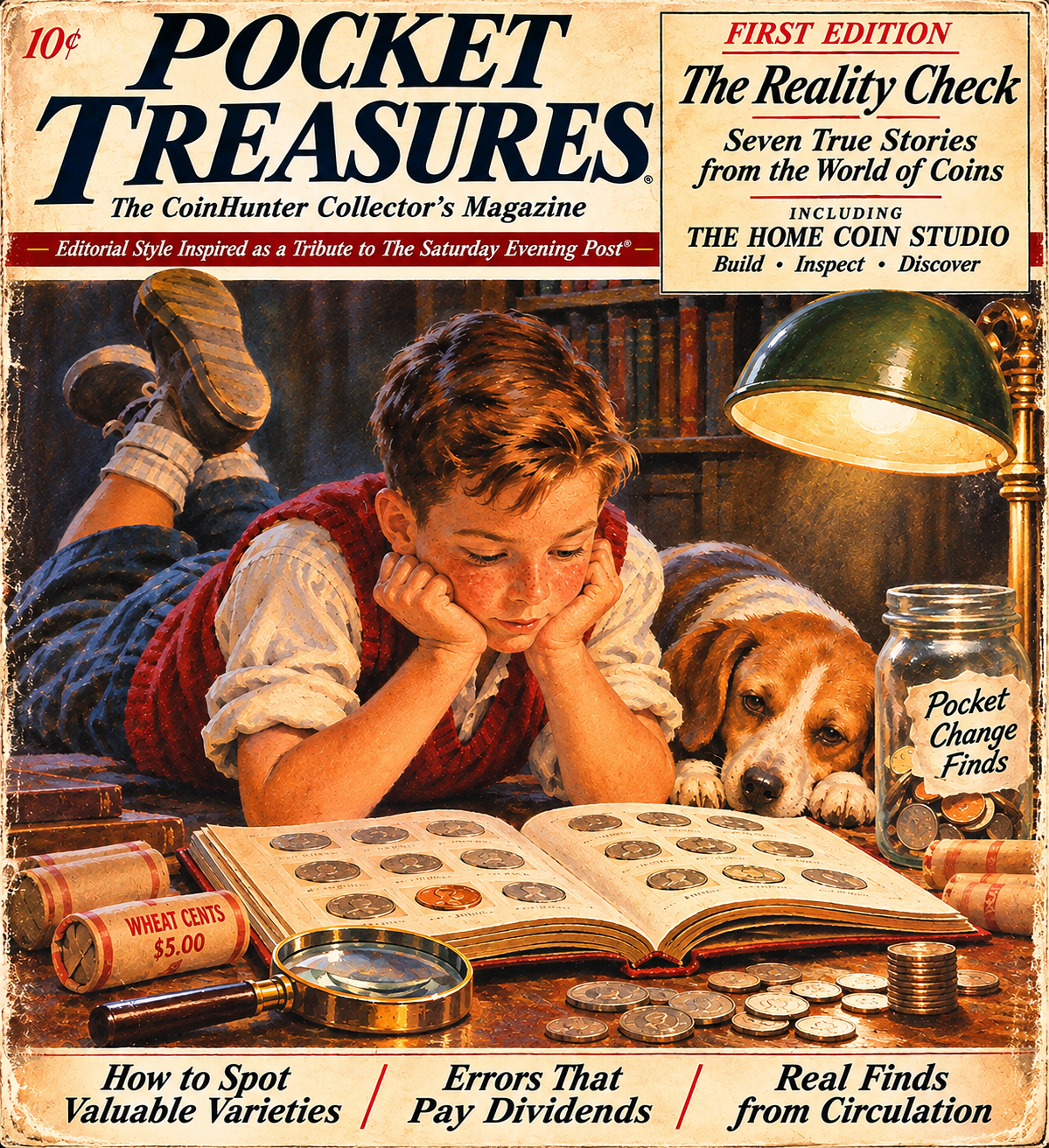
A good coin photograph is a record of visible information. It is not a tiny grading room.

A photograph can help you see

  • the overall design, denomination, date, and visible mint mark;
  • the shape of the coin and the condition of the rim as photographed;
  • scratches, spots, stains, breaks in lettering, and other surface features that the light reveals;
  • the relationship between a date, mint mark, and a known reference image;
  • whether two images plausibly show the same obverse and reverse when framing, orientation, and surface marks agree;
  • whether a slab, holder, or label is present and what its visible number says.

Light direction matters. Raised relief can appear flatter or sharper depending on the angle. A proof coin's mirror-like fields can reflect the room. A toned surface can look different under different color temperatures. Those changes are not necessarily dishonesty; they are reasons to keep the setup and the original file.

A photograph cannot settle everything

It cannot reliably establish weight, specific gravity, alloy, or composition. It cannot show an edge that was never photographed. It cannot prove that a raw coin is authentic, that a mark is mint-made, or that a surface is untouched. It cannot turn an inadequate image into an exact grade.

Certification imagery can help compare a holdered coin to a service record, but a photograph is still not the certification record. A label can be copied. A holder can be replaced. The useful question is whether the object in hand corresponds to the record and whether the record answers the question you actually have.

The same restraint applies to variety hunting. A detail crop can show a possible feature. Attribution requires a recognized diagnostic, a comparison, and enough views to rule out damage or lighting. If the edge matters, photograph the edge. If the coin is flat, the answer may be that the photograph has reached its limit.

The visual desk's favorite caption is therefore not “rare.” It is “visible here.” That is a smaller claim, but it survives contact with a second look.

The practical handoff

Use the photograph to decide what to check next. If the date is visible but the mint mark is not, make a closer mint-mark view. If the edge is important, turn the coin and record it. If a surface looks suspicious, compare the same area under a different angle and against a normal example. If the coin is in a holder, verify the visible certification record through the service named on the label rather than trusting a copied screenshot.

When the photograph has done all it can do, stop asking it to become a laboratory. Weigh the coin with an appropriate scale if composition is a question. Seek a recognized reference or qualified professional if authenticity, attribution, or a high-stakes grade is at issue. The picture remains useful: it tells the next person what you saw, what you could not see, and why you asked for another kind of evidence.

Source note: U.S. Mint terminology for fields, relief, mint marks, proof finishes, and obverse/reverse was checked against its collecting-basics pages. Photography and certification cautions were checked against NGC and PCGS guidance. All diagrams are original illustrations.

Split panel lists visible information on the left and questions a photograph cannot settle alone on the right.
PLATE 1 — Split panel lists visible information on the left and questions a photograph cannot settle alone on the right.
Pocket Change • POCKET TREASURES
07

Pocket Change

The coin that keeps moving

If you photograph a coin today and photograph it again next month, the coin may be unchanged while your description improves. This is one of the quieter benefits of keeping records: your past certainty becomes searchable.

A small mercy

Not every dark coin is rare, cleaned, toned, poisoned, or cursed. Sometimes it is simply dark. Good lighting is the fastest way to reduce the number of supernatural explanations.

The drawer test

Open the drawer where you keep your “temporary” supplies. If the loupe is there, the gray card is there, and the notebook is there, you have a photography studio. If the drawer contains six untested clip-on lenses and no coin, you have a future archaeological site.

The useful question

Before asking what a coin is worth, ask what you would need to know to make the answer less silly. Date? Mint? Grade? Authenticity? A comparable sale? The question is not an obstacle. It is the beginning of the collection.

A collector's weather report

Some sessions are bright: the date snaps into focus, the edge is clean, and the reference image agrees. Some are fog: glare, wear, and an uncertain mark occupy the entire afternoon. Record both kinds. A foggy result is still a useful forecast if it tells you what equipment, view, or reference is missing.

The quiet upgrade

Try moving the light before moving the coin. Try moving the phone before buying a new phone. Try reading the terms before believing the number. The cheapest upgrades are often the ones that make the next observation more honest.

One last look

The best tool on the table is the one that makes you slow down without making you stop. Keep that one close.

Illustrated material in this issue is labeled when it is illustration. No Pocket Change item is a current market claim or a promise of discovery.

THE COLLECTOR'S RESOURCE DIRECTORY • VOL. 1

Worth a Closer Look

Three useful stops for the thoughtful collector. These independent resources are listed for reader convenience, not as paid advertisements or endorsements.

THE GRADING DESK

Professional Coin Grading Service

For grading and authentication information, the CoinFacts reference library, and a starting point for price-guide research.

Visit PCGS at pcgs.com

THE COLLECTOR'S REFERENCE SHELF

Numismatic Guaranty Company

Explore coin certification, collector education, and reference resources before choosing whether professional grading makes sense.

Visit NGC at ngccoin.com

FROM THE MINT

United States Mint

Discover official collector releases, proof sets, commemoratives, and subscription offerings directly from the nation's coin producer.

Explore the U.S. Mint collector shop

Independent editorial directory. CoinHunter has no verified sponsorship, endorsement, or affiliate relationship with these organizations. Trademarks belong to their respective owners. Product availability and services may change.

THE BACK COVER
CoinHunter

One More Look.

Tomorrow's discovery might be hiding among today's change.

POCKET TREASURES • A COINHUNTER PUBLICATION

Independent CoinHunter publication. The Saturday Evening Post is referenced solely as an editorial-style tribute; no affiliation or endorsement is implied.